Amazon EU price comparison: find the same item cheaper
Same product, different price. How to pocket the difference.

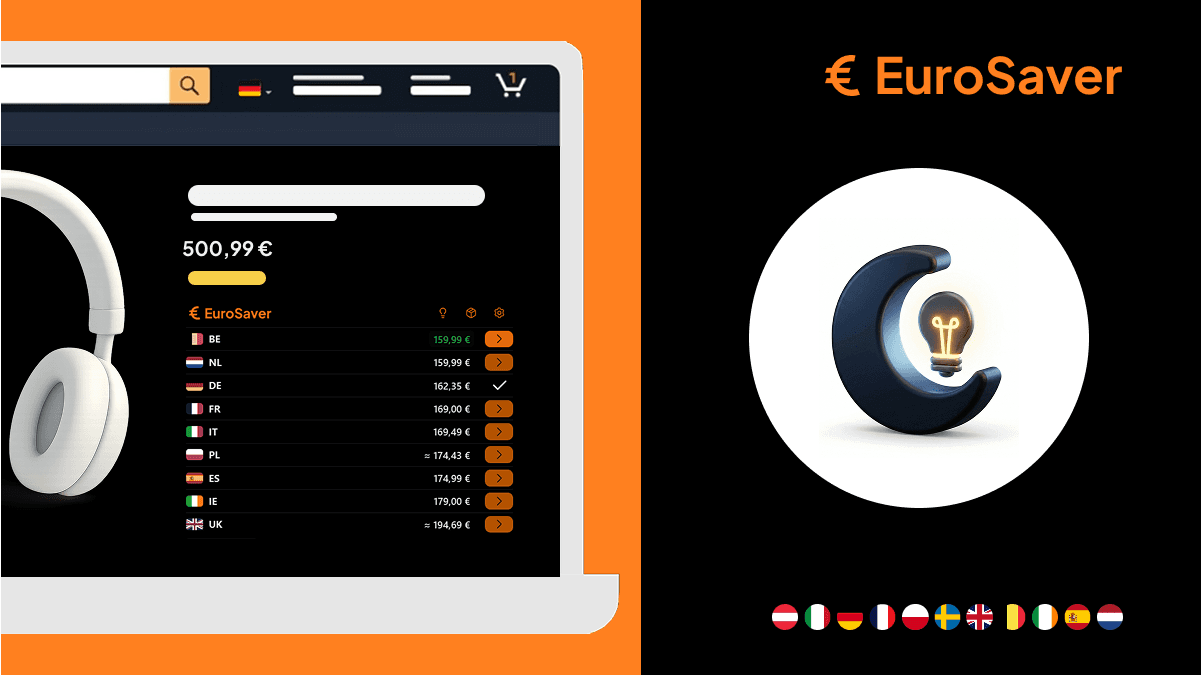
An Amazon EU price comparison puts amazon.de, amazon.fr, amazon.es and the other European stores side by side. Because each country store runs its own pricing strategy, amounts for identical products with the same ASIN regularly differ by double-digit percentages. You only see the real best price once product price, shipping and taxes have been added up.
Same product, same product number, two completely different prices. In European online retail that is normal, not a system error.
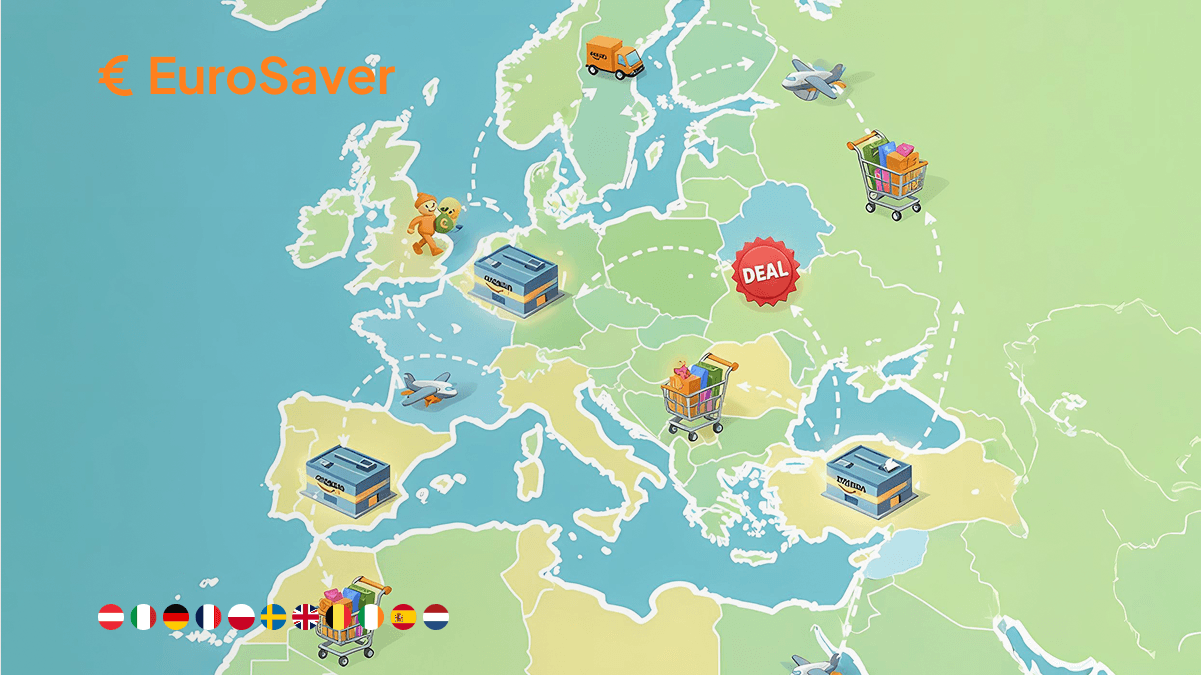
Amazon operates several independent stores in Europe, and each one calculates according to the logic of its home market. For buyers this independence is the opportunity: you can choose which country you order from.
Why do Amazon prices differ by country?
There is no single European pricing scheme. Every country store adjusts its prices continuously to local market conditions, sometimes several times a day.
The most important lever is local demand. If an electronic item sells worse in Italy than in Germany, Amazon lowers the price in Italy to clear stock. Competition plays a role too: in countries with strong regional online retailers, Amazon has to price more aggressively. The same headphones can therefore cost noticeably less in Spain or France than elsewhere.
The second lever is discount campaigns that run in only one country. While nothing is happening for household appliances in one store, a discount week for exactly that category may start in another.
A price comparison is always a snapshot. Anyone who saves regularly takes a quick look at neighbouring stores before buying.
The listed price is rarely the final price
If you only look at the number on the product page and order straight away, checkout holds a surprise. The final price consists of several items, and two of them only appear in the last step.
Adding cross-border shipping costs
A cheap offer in a foreign store quickly loses its appeal once delivery costs come on top. Within its own country, Amazon often delivers free above a certain order value; across borders almost never. The amount depends on weight, parcel size and the dispatching fulfilment centre.
A five pound price advantage is worth nothing next to six pounds of postage.
Checking currency and exchange rate
Not every European Amazon marketplace bills in euro. On amazon.co.uk prices are in pounds, while amazon.se or amazon.pl show Swedish krona or Polish złoty. If you buy there, your final amount depends on the daily rate.
Refuse the Amazon Currency Converter where it is offered. It usually gives worse rates than your bank or card provider. Choose billing in the original currency and let your payment provider do the conversion.
Import charges replace any checkout adjustment
Within the EU, Amazon recalculates VAT at checkout based on the delivery address. That mechanism does not apply to orders arriving in the UK: the UK is outside the EU customs union, so goods leave an EU store as an export. No EU VAT reduction appears at checkout.
Instead, UK import charges apply on arrival. Import VAT of 20 percent is due on the goods value plus shipping, collected either by Amazon at checkout for eligible listings or by the courier before delivery, usually with a clearance fee of around £4 to £8. Above £135, customs duties can also apply depending on the product category.
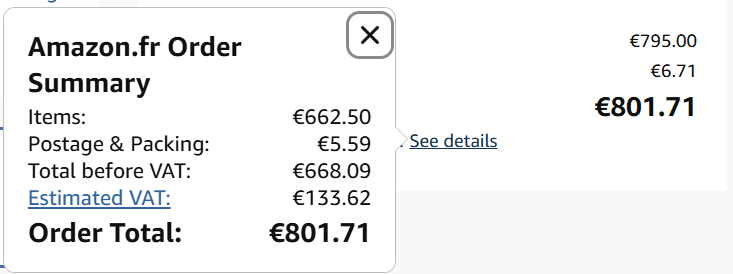
Worked example: coffee machine at amazon.co.uk and amazon.de
A coffee machine costs £89 on amazon.co.uk. The same model is listed at €89 (about £76) on amazon.de. Ten pounds cheaper at first glance, according to the product page.
| Marketplace | Listed price | Shipping to GB | Import charges (approx.) | Actual final price |
|---|---|---|---|---|
| amazon.co.uk | £89.00 | £0.00 | £0.00 | £89.00 |
| amazon.de | €89 ≈ £76 | £6.50 | £16.50 import VAT + £4 handling | £103.00 |
Once the parcel enters the UK, 20 percent import VAT applies to the goods value plus postage, and the courier adds its handling fee. The ten pound saving turns into a fourteen pound surcharge. Only when all total costs stand side by side do you know which offer wins.
For UK shoppers this example is typical: since Brexit, EU stores rarely win on price alone. They win on selection — products never listed on amazon.co.uk, or temporarily out of stock there.
What to watch out for when buying from abroad
Consumer protection still applies, but different rules than inside the EU. A good deal can fail at a few practical points.
Dispatched from and sold by Amazon or a third party?
A large share of products on Amazon does not come from Amazon itself but from marketplace sellers. Check abroad exactly who is listed as the seller. Where Amazon handles dispatch, the usual standards for delivery time and reliability apply. When a foreign seller ships itself, delivery often takes longer and returns get more complicated, because the seller's registered business may sit outside the UK.
Statutory rights, warranty and return costs
In the UK, purchases are covered by the Consumer Rights Act 2015: goods must be of satisfactory quality, as described and fit for purpose, with short-term right to reject within 30 days. Buying from an EU-based seller means dealing with that seller under its national implementation of EU consumer law instead, which can make enforcement slower. Voluntary manufacturer warranties are separate: some manufacturers restrict them to the country where the device was bought.
The point most often underestimated is the cost of returns. If you send a product back because you do not like it, you usually pay the insured international postage yourself. For defective or wrongly delivered goods, Amazon or the seller covers the cost. With heavy or bulky items, postage eats the price advantage in one go.

Amazon price comparison without twelve open tabs
By hand the comparison is work: copy the ASIN, open country pages, click every offer through to checkout to see shipping and charges. Three countries and two products keep you busy for a quarter of an hour.
There are websites for this purpose, such as the ones compared in EuroSaver vs. Hagglezon. Most require copying your link manually onto an external platform. How our approach works in detail is described on the welcome page.
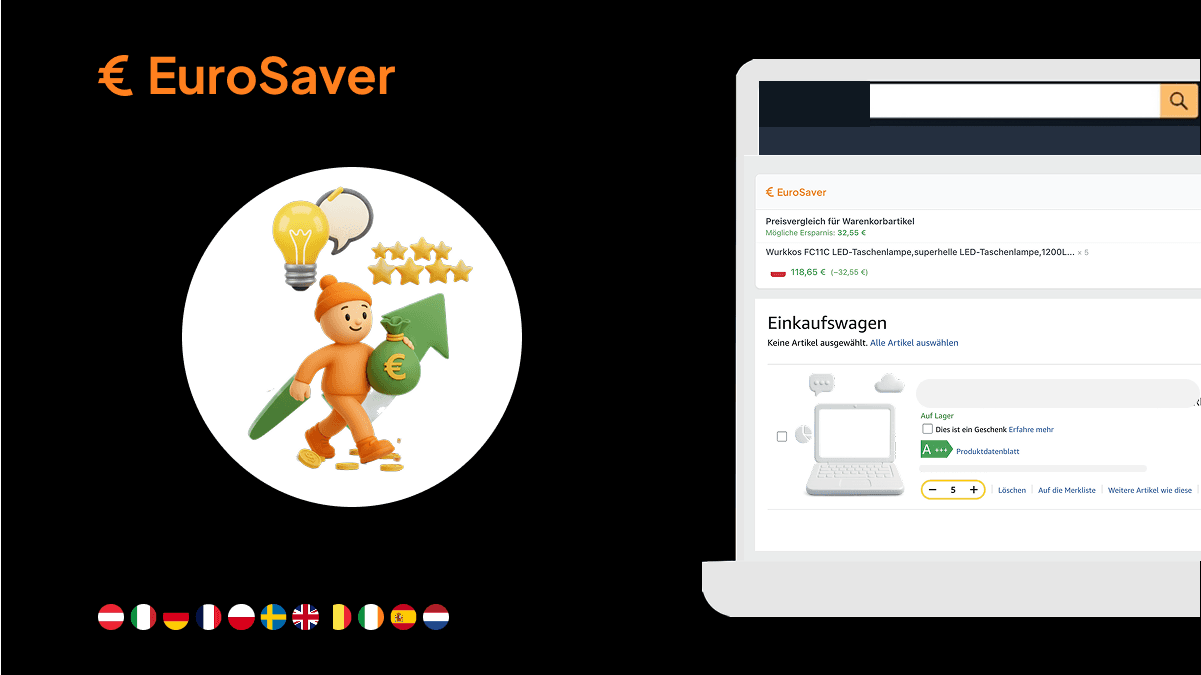
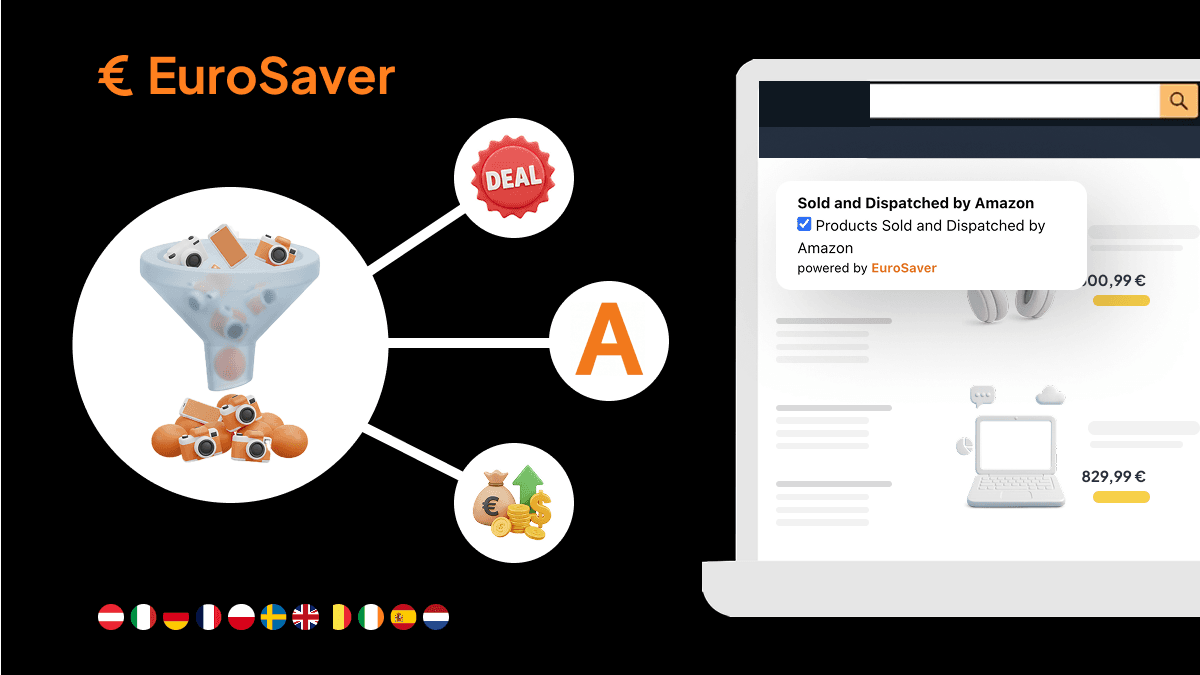
EuroSaver starts where the problem arises: on the Amazon product page. The free tool compares European marketplaces in the background, converts currencies and shows the costs involved without you switching tabs. You see immediately whether looking across the border pays off.
When looking across the border is worth it
For UK buyers the calculation differs from the EU neighbours': after import VAT and handling fees, EU stores hardly ever win on price. They win on availability. Electronics, household appliances, tools and branded products that are out of stock or never sold on amazon.co.uk are the real use case. There, paying import charges beats not getting the item at all.
Everyday items, books and small parts under £20 are almost never worth an international order. The differences sit in the pence range, and import charges swallow them instantly.
Check the country variant too. Laptops from France or Italy come with that country's keyboard layout, devices from outside Europe may need plug adapters.
Install EuroSaver if you want to compare Amazon prices in Europe in seconds instead of minutes.
FAQ
Can I log in abroad with my usual Amazon account?
Yes. On almost all European Amazon marketplaces such as amazon.de, amazon.fr or amazon.es your existing credentials work, and payment details and delivery addresses are normally carried over. Under certain conditions amazon.com behaves differently, although the same account can usually be used there too.
How much is shipping from an EU store to the UK?
It depends on weight, size and marketplace. For standard parcels from Germany, France or Spain to the UK, fees typically run between £5 and £12. The exact amount is shown in the last step before purchase.
Who pays return costs on a purchase from abroad?
If you return because you changed your mind, you normally bear the international return postage yourself. If the goods are defective or wrongly delivered, Amazon or the marketplace seller refunds the return costs under the applicable consumer rules.
Should I use the Amazon Currency Converter?
Usually not. Amazon's conversion rate generally comes out worse than the one from your bank or card company. Choose billing in the original currency at checkout; your payment provider then converts.
Does the price still change during ordering?
Yes, in both directions. For deliveries into the UK, no checkout VAT adjustment appears, but import VAT and handling fees arrive afterwards. Add cross-border shipping. Always compare final totals, never the numbers on the product page.