Amazon price comparison with shipping costs: why the cheapest price is not always the best buy
How shipping, tax and seller type move the final price
An item costs 45 € (about £38) on amazon.es and £45 on amazon.co.uk. Seven pounds of difference; the decision seems clear.
It is not. Between product price and the amount leaving your account sit three items: shipping costs, the UK import charges on arrival, and the question of who actually dispatches. Together they decide which offer is truly cheaper — and the outcome flips more often than expected.
Why the product price alone tells nothing
Most comparisons look at the number beside the product photo because it reads easiest. For a purchase decision it is incomplete.
Within one country this barely shows: delivery vanishes with Prime or above a threshold, and tax is equal for everyone. As soon as a border intervenes both change.
Shipping costs: flat fee plus weight
Ordering from the UK on amazon.it, amazon.fr or amazon.de, nearly every consignment carries a base fee plus a weight component. For standard parcels usually between £4 and £12.
With heavy or bulky articles that quickly becomes an amount swallowing every advantage. Kitchen appliances, tools or monitor arms are the typical cases: £10 saved on product price, £14 postage — and you paid over the odds.
One often-missed point: shipping applies per order, not per article. Whoever takes several things from the same store pays once. Often the second-best price within one store comes out cheaper than three best prices scattered.

Import charges replace any checkout adjustment
Within the EU, VAT shifts to the destination country at checkout since 2021 — but orders arriving in the UK see none of that. Goods leave the EU store as exports; UK charges land after purchase instead:
- Import VAT of 20 percent on goods value plus postage.
- Courier clearance fees, typically £4 to £8 per parcel.
- Customs duties above £135 depending on category.
Do not count these as minor add-ons. On a £38 item they add roughly £9–10 before the courier fee, easily erasing a seven pound headline saving on its own. They matter mainly for interpreting why the amount you eventually pay exceeds what the foreign product page showed, see Why the price at checkout differs from the product page.
Who dispatches also decides
A large share of offers comes not from Amazon itself but from third-party sellers. There lie the biggest differences in delivery costs across the whole comparison.
Dispatched from and sold by Amazon. Standardised flat rates, calculable, and in case of complaint Amazon remains your contact.
Fulfilment by Amazon, sold by third parties (FBA). Logistics run through Amazon but goods rest in the origin country's warehouse. Cross-border shipments there often carry higher fees than Amazon's own retail.
Fulfilled by the merchant (FBM). Here the seller sets their own rates. An Italian seller can ship cheaply domestically and charge 19 € for a parcel to the UK. Two offers with identical product prices can diverge by double-digit amounts in total.
The label «dispatched by seller» is precisely the point where you check delivery costs before ordering. How to filter Amazon's own offers: How to find products dispatched from and sold by Amazon.
Customs and returns
No customs within the EU. Orders from France, Italy, Spain, Poland or the Netherlands into other EU states arrive free of levies — but into the UK they are imports, with the charges described above.
The bigger cost factor sits at the other end. Return it because you changed your mind: international return postage usually falls to you. Defect or wrong item delivered: Amazon steps in.
On bulky goods this is decisive: an insured parcel back to Spain easily costs more than the advantage gained. So factor the possible return in as risk for anything likely to come back. Added to that, customer service operates in each store's language.
The calculation with an example
A coffee machine, sought by a UK customer:
| Cost item | amazon.es | amazon.co.uk |
|---|---|---|
| Product price (displayed) | 45,00 € ≈ £38 | £45.00 |
| Import VAT 20 % + courier fee | + £11.50 | £0.00 |
| Shipping costs | + £7.00 | £0.00 |
| Final price including charges | £56.50 | £45.00 |
On the product page it looked like seven pounds of saving. In the end it is eleven pounds of extra cost — plus a weaker position should anything need returning.
The example shows the typical UK picture: the foreign sticker price grows through import VAT and postage. Exactly the pattern: postage decides, import charges adjust afterwards — and adjust upwards almost always.
Different picture if you order a second machine or accessories from the same store at once: the £7 falls only once, though import VAT still applies per shipment value.
When buying abroad makes sense
As orientation: the price gap must clearly exceed shipping plus expected import charges, not narrowly. A £12 advantage against £18 of postage and duties is no deal once something goes wrong.
It works well for light articles of high value where the gap runs large, for several products from one store, and for offers dispatched and sold by Amazon.
It works badly with heavy or bulky goods, with slim advantages, and with everything where a return is probable — clothes, for example.
Seeing the final price without clicking through five checkouts
Real shipping costs stand in the last order step of every store. Playing that scene for five countries takes longer than the purchase itself.
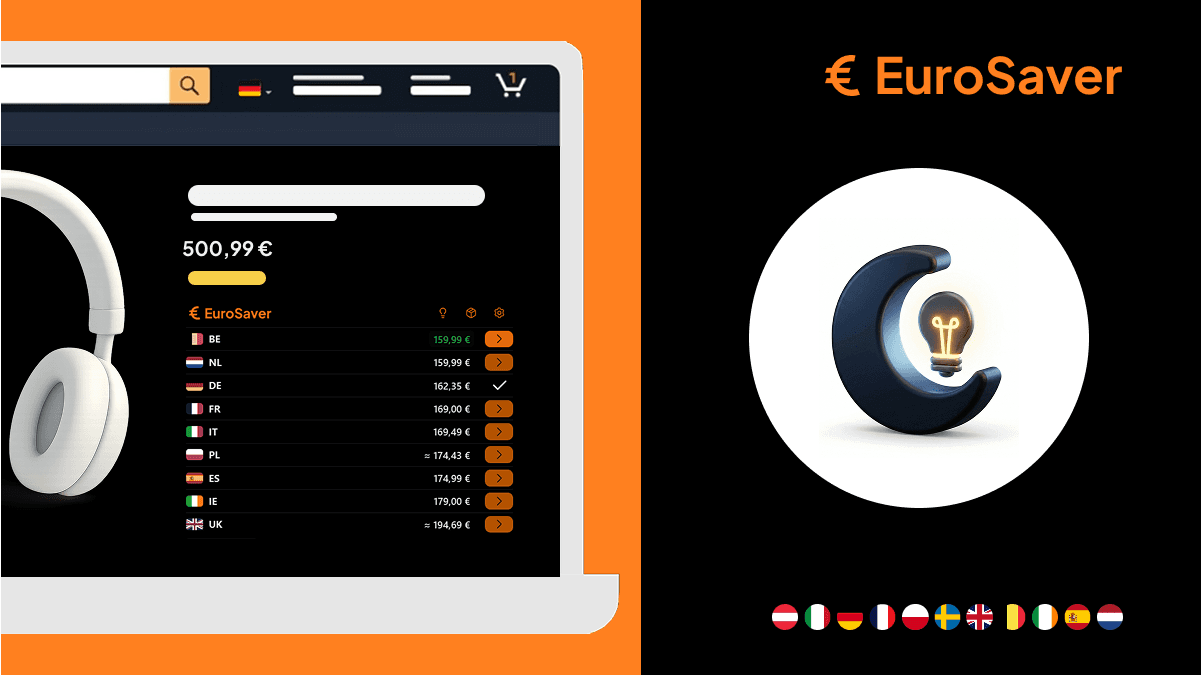
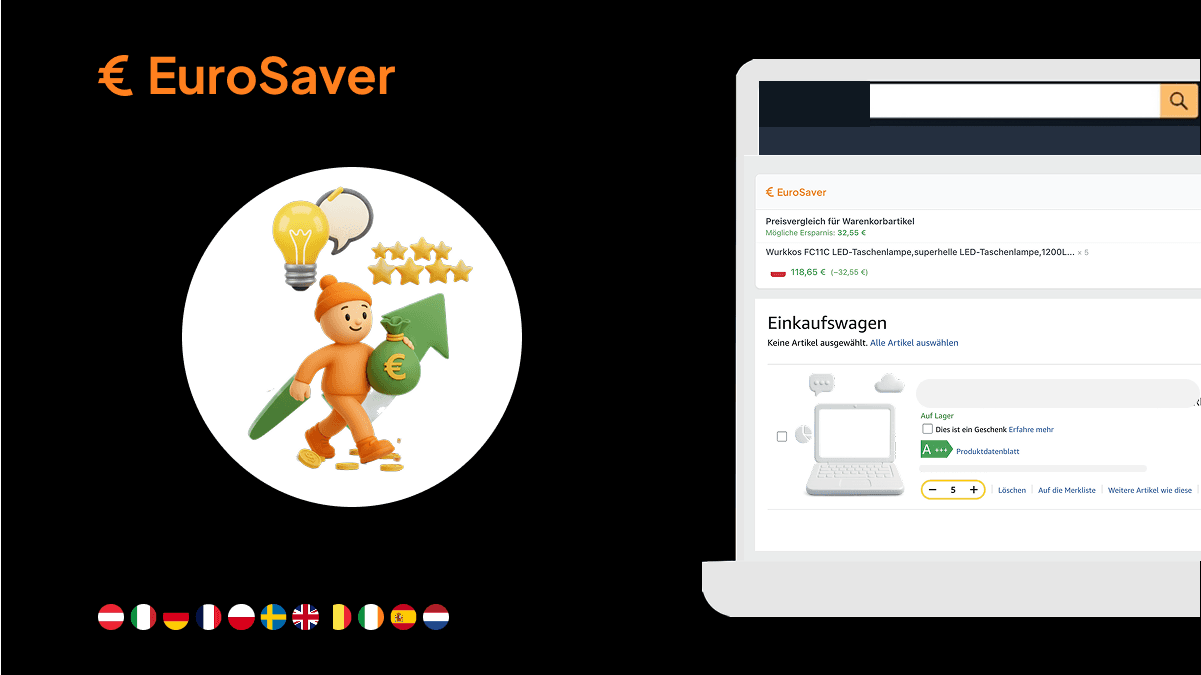
EuroSaver incorporates the shipping costs Amazon publishes for your delivery country directly into the product page display and converts currencies. That way you see in advance which offers merit the effort at all.
Two limits worth knowing: the display does not anticipate import charges, which arise only after purchase. And with marketplace sellers shipping themselves actual costs may differ. The last order step remains binding, see Amazon EU price comparison.
FAQ
Why do shipping costs vary so much within Europe?
They depend on weight, size, route and who dispatches. Amazon's own deliveries follow standardised flat rates; marketplace sellers shipping themselves set their rates freely.
Do I see the price with UK taxes in the foreign shop?
No. The product page shows the price at that country's rate, 21 percent in Spain for example. No EU checkout adjustment follows for UK addresses; instead import VAT and courier fees apply when the parcel arrives.
Does my UK Prime membership work on amazon.it or amazon.de?
No. Prime is tied to the store where you subscribed. On foreign marketplaces you pay regular shipping unless you separately subscribe to Prime there too.
Is it worth ordering several items from one store?
Yes, mostly clearly. Shipping applies per order, not per article. From the second article of the same store the calculation improves noticeably.
Where do I see the real shipping costs?
In the respective store's last order step, once the delivery address is stored. Figures on the product page are estimates.